

I was so proud to be part of the “Body Language” show at City Winery in April co-produced by Writers Read and the Bellevue Literary Review. The cast of writers read 5-minute, true personal stories about illness, recovery, and what you discover in between. My piece was about the long afterlife of finding out you have hepatitis C.
Three Ways of Looking at a Diagnosis
Ann Levin
Even now, fifty years later, I still cringe when I see the track marks on my arms. It happened to me just the other day when I was walking to the park, glanced down at my forearms, and caught a glimpse of bleached skin and tiny white scars arrayed atop the faint blue river of a vein.
Then a bird soared overhead, and suddenly I remembered the Wallace Stevens poem “Thirteen Ways of Looking at a Blackbird.” Fine, I thought. I can think of three ways, at least, to look at my diagnosis of hepatitis C, which I got along with the tracks from doing IV drugs in college eons ago.
First, there was my way: remorse. After I was diagnosed in 2000, I kept it a secret from everyone but my family. I was so ashamed that I spent that period of my life hanging out with junkies instead of taking a junior year abroad in Paris. But over the two years and three months I spent trying to eradicate the virus, I met plenty of people who had no regrets. Lillian, for instance, who couldn’t have been more different than me.
I met her in a support group at Mount Sinai not long after I found out. She had the careless glamour of a seventies-era rock star, like Bonnie Raitt or Emmylou Harris. Tall and lanky, with whitish blond hair and unblinking blue-gray eyes, she was on a first-name basis with the six best hepatologists in town. I wondered where she got the confidence when I cowered before them, intimidated by their white coats, mortified by the fact that they’d gone to medical school when I was sticking dirty needles in my veins. Lillian said the two years she spent shooting heroin was the best time of her life, but she knew it was unsustainable, so she quit. She turned her diagnosis into a crusade, organizing busloads of people to go to Albany and Washington to raise awareness of the disease and push for cheaper, better drugs. She never lost her zeal for advocacy work even though she had to try eight different therapies over eighteen years and was on a waiting list for a transplant before the meds finally worked.
Then there was the Ad Man, who was in the hospital bed beside me after we’d both gotten liver biopsies. I never found out his name, just that he graduated from Wharton and had a flashy job in advertising. He was about my age, good-looking in a preppy sort of way, with dark hair parted on the side and bronze skin suggesting he either had parents who lived in Florida or patronized tanning salons.
I asked him if he felt any stigma about the diagnosis.
“Nah,” he said, his eyes glued to the TV on the wall. ”That was party time, man. Sex, drugs, and rock ‘n’ roll.”
When I told him that the side effects of interferon and ribavirin, then the gold standard of treatment, sounded scary and the odds of it working were crap, he tilted his head toward me — we weren’t supposed to move our abdomens — and said, “Que sera, sera.” Then he went back to watching TV.
I, on the other hand, was freaking out about all the possible adverse reactions to the treatment. It seemed “barbaric,” like the icicles that filled the long window in Stevens’ poem though eventually, it worked.
Every now and then, I wonder if people even notice the tracks anymore. It would be hard to distinguish them from all the other ravages of time: the age spots, keratoses, mysterious red scratches that look like I slept in a blackberry patch, and warty, brown bumps — a far cry from the dewy skin of a hot college co-ed.
So maybe there was a fourth way to look at this diagnosis: At this point, who really cares?
…
To watch a video of me reading the story, click here.
…
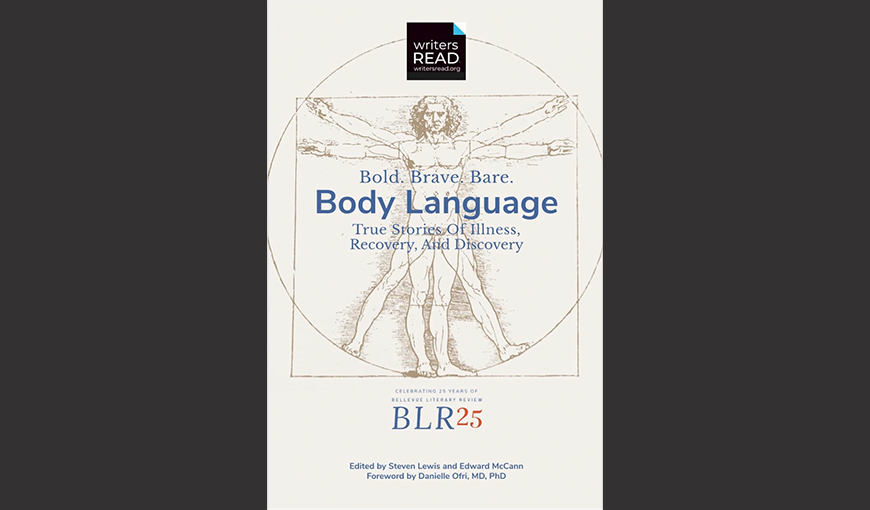
If you missed the show – or are curious to read more – the 16 stories presented on stage, plus 20 others, have been collected in a Writers Read anthology, Body Language: True Stories of Illness, Recovery, And Discovery, edited by Steven Lewis and Edward McCann with a foreword by Danielle Ofri, MD, PhD. To buy a copy of the book, click here.
…
To watch a short segment about the April 12 show on the PBS News Hour, click here.